
The Real Risks of Waiving a Home Inspection in Montreal
Your real estate broker calls on a Thursday evening. There are eleven promises to purchase on the property, and two of them have dropped the inspection condition.

Ivan Mose
Founder and CEO, Certified
Master Inspector
The question that follows is always the same. Do you need to do the same thing to stay in the running? It is a decision made in a few hours that commits you for years. It deserves better than a reflex. This article explains what you concretely give up by removing that condition, why the hidden defect recourse does not replace what you lose, and which approaches let you make an offer competitive without surrendering your right to know.
What the Condition Actually Gives You
In a promise to purchase, the inspection condition grants you three distinct things, and it helps to separate them.
The first is time. You get a defined window, often five to ten days, during which the property comes off the market while you do your verifications. That time seems like nothing until the moment you have to coordinate an inspector, a drainage contractor, and a master electrician in the same week.
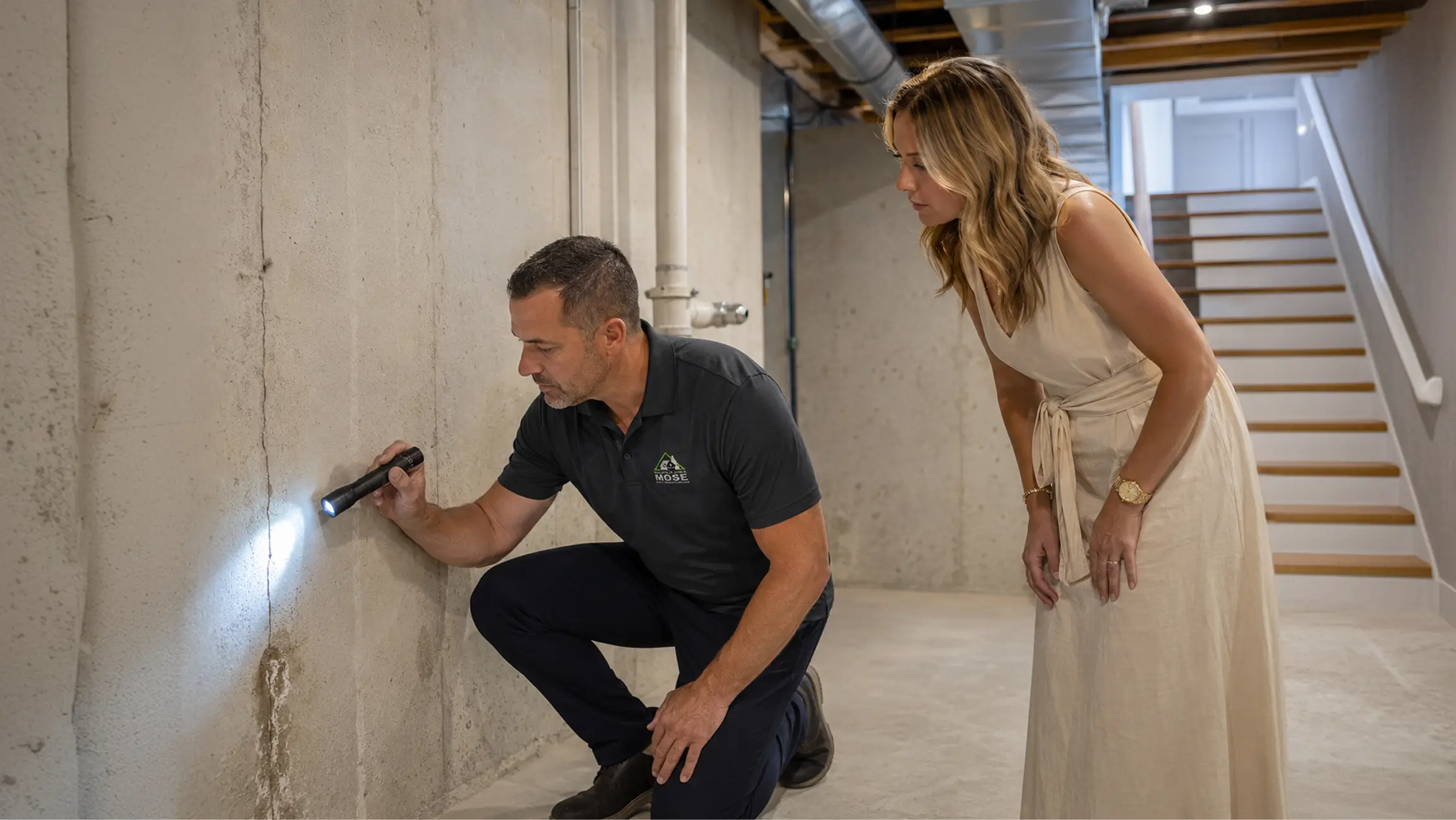
The second, access. The condition gives you the right to enter the house with a professional, open the electrical panel, climb into the attic, run the water for twenty minutes. None of that is possible during a forty-five minute open house with six other buyers in the hallway.
The third, an exit. If the inspection reveals a situation you would rather not take on, the condition lets you withdraw according to the terms set out in the contract, or open a conversation with the seller. Without it, your promise to purchase becomes firm as soon as it is accepted. You buy the house as it stands, with what you know and with everything you do not know.
It is that third element buyers underestimate most. Removing the condition does not just cost you a report. It costs you the moment when information and the power to act on it exist at the same time.
Hidden Defects Can Be a Recourse: Not a Safety Net
Many buyers reassure themselves by thinking that if something bad turns up, the legal warranty of quality under the Civil Code of Quebec will protect them. That warranty does exist, and it is more generous than in most of Canada. It is not the equivalent of an inspection, for three reasons.
First, the defect must be hidden. A problem a prudent and diligent buyer could have detected through careful examination is considered apparent, and the warranty does not apply to it. Quebec courts take the buyer’s diligence into account, and having voluntarily waived all verification does not work in your favour.
Second, the defect must be serious, must have existed before the sale, and must have been unknown to you at the time of purchase. A roof reaching the normal end of its service life is not a hidden defect. Neither is predictable wear.
Third, a recourse unfolds after the fact. You have to send written notice to the seller within a reasonable time, have the problem assessed, often retain a lawyer, and sometimes wait months or longer. Meanwhile, you are living in the house and living with the problem. To understand your specific rights and deadlines, the right person to consult is a lawyer or your notary, not your inspector. Learn more.
A home inspection Montreal buyers arrange does not replace the legal warranty, and the legal warranty does not replace the inspection. The first informs you before you commit. The second offers a recourse, long and uncertain, after you have committed.
Pressure to Sign is Going Up in the Montreal region
The temptation to drop the condition does not come from nowhere. In several sectors of the island, in Laval, and increasingly in Vaudreuil-Dorion, well-located and correctly priced properties still attract multiple offers. A seller comparing two promises to purchase at the same price will almost always choose the one with fewer conditions. The logic is understandable.
What that logic overlooks is the nature of the local housing stock. A large share of homes in the region are between sixty and one hundred years old. They have original French drains, modified attics, electrical panels replaced twice, flat roofs redone in successive sections.
These are precisely the buildings where verification has the most value, and they are often the ones that trigger bidding wars. Put differently, the properties where buyers feel the most pressure to skip a home inspection Montreal sellers know will turn something up are the same properties where skipping it costs the most.
There is also a less visible effect. When several buyers waive the condition in the same neighbourhood, it becomes the expected norm, then the required one. The question stops being “should I?” and becomes “do I have a choice?”. You have more choice than you think.
How to Stay Competitive Without Waiving
There is room between a standard ten-day condition and outright waiver. Here are the approaches we see working in practice.
The pre-offer inspection.
When the seller allows it, you have the property inspected before submitting your promise to purchase. You then present an offer with no inspection condition, but with full knowledge of what you are buying. This is the strongest option when the timeline permits it.
The information-only inspection.
You keep the access and the report, but the condition is not used as a renegotiation lever. Some sellers see this as an acceptable compromise, since the risk of the transaction collapsing over minor corrections disappears.
The shortened deadline.
Three business days instead of ten, with an inspector already booked. A short deadline is often nearly as attractive to a seller as no condition at all, and it leaves your exit intact.
The monetary threshold.
The condition can only be invoked if corrections estimated by a contractor exceed an agreed amount. That reassures the seller that the sale will not derail over a handful of ungrounded outlets.
Each of these routes has to be drafted properly in the promise to purchase. That is the work of your real estate broker and, where needed, your notary. Talk to them before you choose.
The Bottom Line
Waiving the inspection condition is a legitimate decision, and it is not a building inspector’s place to tell you what to do with your offer. What we can tell you is what you are trading: information at the moment it is still useful, in exchange for a recourse that exists but arrives later, and costs time and energy. In a housing stock as old as Montreal’s, Laval’s, and Vaudreuil-Dorion’s, that trade is not a small one. If you are preparing an offer and want to understand what a home inspection Montreal buyers book can cover on a tight deadline, write to us. We will explain what is realistic before you make your decision.
Disclaimer: This article is intended for general informational purposes only. Mose Home Inspection Services does not provide repair cost estimates, contractor recommendations, or opinions on the financial terms of any real estate transaction. All inspection services are conducted in accordance with recognized Quebec standards of practice (APCHQ, AIBQ, BNQ 3009-500). For repair pricing and contractor selection, consult a licensed professional in the relevant trade.